 View Cart
Learn how to be FOUND
What the Isle Royale Rescue Can Teach Every Hiker
By Thomas Funke
We’ve heard the story: Experienced 70-year-old hiker goes missing on Isle Royale.
After eleven harrowing days, Craig Berg, 70, of Royal Oak, Michigan, wasn’t found by the search-and-rescue crew looking for him. He wasn’t found by park staff, the Coast Guard, or other hikers.

He was found by two kayakers on Intermediate Lake, which is on a popular paddle route—and more than a mile from the Greenstone Ridge Trail.
Berg had taken the boat to Windigo, and the plan was to hike the Greenstone Ridge back to Rock Harbor. But somewhere along the way, he lost the trail and ended up on a lake about a mile south of the Greenstone Ridge. And then he went days without being found.
Granted, Isle Royale is a wilderness. There are no roads, but there are well-traveled trails. The Greenstone Ridge Trail is a virtual highway that runs along the highest ridge on the island.
But eleven days? Why was he so difficult to find? That is the question I keep coming back to.
Experience Doesn’t Make You Immune
Experience can make us better hikers. It can also make us confident enough to believe that the things that happen to inexperienced hikers won’t happen to us.
I’ve been lost more than once. Heck, I’ve had SAR called out on me on one occasion. Getting lost does not mean someone is inexperienced. It means something went wrong.
It’s staying lost that makes me ask what happened here—and how we can learn from it.
The Greenstone Ridge Trail didn’t disappear. So how did an experienced hiker end up more than a mile from an established trail? We don’t yet know the answer. The reason Berg could not find the trail, or why he even left it in the first place, still hasn’t been disclosed.
There are plenty of possibilities. Perhaps he became disoriented. Perhaps he deliberately left the trail and could not find it again. Perhaps a route change contributed to the problem. The most common way something like this happens is surprisingly simple: Someone steps off the trail to use the bathroom, gets turned around, and suddenly cannot figure out which way they came from.
Whatever happened, there is a critical difference between “I am temporarily off the trail” and “I do not know where I am.”
The first is an inconvenience. The second is an emergency.
When you don’t know your location, use STOP: Stop, Think, Observe, Plan.
And if you are hopelessly lost, stay in one place. A stationary target is easier to find than a moving one.
But I’ve Got a Map
From the reports I’ve seen, Berg was averse to taking a GPS, an emergency beacon, or even a compass. I have read that he had a cellphone and a map.
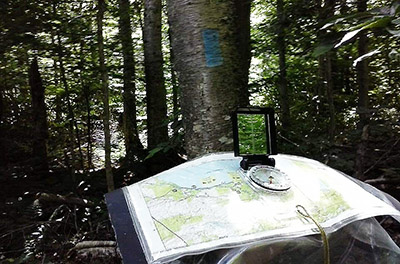
But having a map, GPS, compass, or any other navigation tool is not navigation.
Knowing how to use them is.
He apparently was using the sun and the map to find his way around, which is doable. But he ended up south and way off trail.
To be fair, I haven’t read whether he was trying to get to shore, find the Greenstone, or reach another trail. And until we know more about what happened, I don’t want to speculate about his decisions.
But this is where basic navigation becomes important.
The typical navigator continuously uses their tools to recognize terrain, knows where the next intersection is, monitors progress, and maintains a general sense of direction.
Most importantly, when something doesn’t feel “right,” stop and figure out what is going on before a small error becomes a large one.
Because the best time to discover that you don’t know where you are is before you don’t know where you are.
My Kingdom for a Compass
If the reports that Berg didn’t carry a compass prove accurate, why would he do that? Especially when a compass weighs next to nothing.
It’s bad enough that there are too many hikers relying on GPS and satellite technology, thinking that will replace basic navigation skills. It shouldn’t.
GPS and satellite technology should supplement basic navigation skills, not replace them. A GPS can fail. Batteries die. Electronics get wet. Devices get lost. And, as Berg’s case illustrates, a cellphone can end up at the bottom of a marsh.
That is why I still believe every wilderness traveler should know how to navigate with a map and compass.
But there is another part of wilderness travel that receives far less attention.
The Moose in the Room
Most hiking instruction concentrates on how to get from point A to point B. Far less attention is given to what happens when I can’t?
Every wilderness traveler should know three things:
- How to avoid getting lost.
- What to do when they become lost.
- How to make rescuers find them.
It is this last point that perplexes me.
How many hikers have we read about who have lost the trail and gone days before being found—or not been found at all? There is a fundamental difference between knowing how to navigate and knowing how to be found. And I think we need to teach both.
Learn How to Be Found
Three simple tools that can help you be found are a whistle, a signal mirror, and a fire starter.
I believe it will come out that Berg had no whistle or mirror. But what backpacker doesn’t have matches or a lighter?
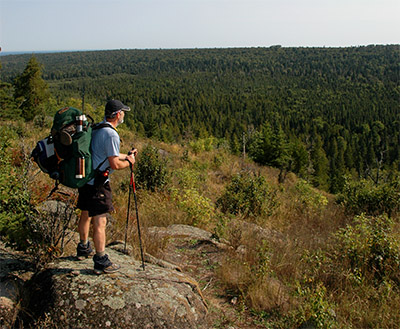
A whistle weighs, what, an ounce? It costs a few dollars and can be heard much farther than a human voice. Why wouldn’t every backpacker carry one? Three blasts are a widely recognized distress signal. Blowing a whistle uses very little energy. Shouting is exhausting, and voices don’t carry as far as the piercing trill of a whistle. A whistle doesn’t require batteries. It doesn’t need cell service. It doesn’t need a satellite connection. You simply blow it.
The second is a signal mirror. If your family loves you, they will report you missing. Ideally, they will send up a plane to look for you.
Using the sun and a little geometry, you can “flash” an airplane with light reflected from the sun. In addition, pilots of regular airplanes, like floatplanes, know that if they are being flashed, they should report it.
A mirror isn’t useful in every situation. It doesn’t work at night, and dense forest can make it difficult to use effectively. But when an aircraft is overhead, it can be extraordinarily effective.
As a last resort, there is the signal fire. Three separate fires are an internationally recognized distress signal. These fires are meant to have flames visible from great distances. A smoke signal can also be effective.
With a signal fire, you create a column of smoke using green vegetation. If the wind is blowing too much, that’s OK; smoke along the ground works, too.
Nothing gets a pilot’s attention more than a column of smoke—or what looks like a forest fire. And that is what I ask every time I read a story like this: Why didn’t they start a signal fire? My goodness, you’d be found and have plenty of time to get to Rock Harbor Lodge for dinner.
Of course, a fire isn’t always appropriate. Weather, fuel, fire restrictions, terrain, and the risk of starting a wildfire all have to be considered.
But the larger point remains: You need to have a way to attract attention.
The Cellphone
Who doesn’t carry a cellphone when hiking? In civilized areas, I know I can use it to place a call if I get hurt, etc. I’d rather use a cellphone than start a signal fire. But in remote areas like Isle Royale?
Solely for photographs.
Berg had his, and he was using it to make calls and send texts. But a cellphone doesn’t work at the bottom of a marsh, which is where it ended up. And that is precisely why a cellphone shouldn’t be your wilderness emergency plan.
Today, hikers have access to GPS devices, satellite messengers, personal locator beacons, and other technology that can dramatically reduce the amount of time someone spends missing.
Use them. But don’t let technology replace the skills that existed before the technology. Know how to read your map. Know how to use a compass. Know where you are. And know what to do when you don’t. Because you can have all these tools and skills, but wandering around the landscape is not what you should do. At some point, you need to stop and stay put if you are unable to navigate.
The Search-and-Rescue Perspective
Always assume someone is looking for you if you haven’t been found. Now put yourself into Search and Rescue’s shoes.
Searchers aren’t just randomly looking for someone in the forest over a wide area. They need to narrow their search area. The smaller the search area—provided you are in it—the quicker they will find you and the fewer resources they will use.
Think about what happens when you continue walking after becoming lost. You started at a known location. Then you walked a mile. Then another. Then another. Now the people searching for you have to consider all the places you might have gone. Every mile you walk after becoming lost can make someone else’s job exponentially harder.
And that’s why the most important piece of advice I can give any hiker who realizes they are truly lost is simple: Stay put. Make yourself known. Learn how to be found.
You may be an experienced hiker. You may know how to read a map. You may know how to use a GPS. You may have hiked hundreds of miles. None of that guarantees that you will never get lost.
But you can make damn sure that if you do, you give Search and Rescue every possible opportunity to find you.
Thomas Funke is a serial Hiker. Lover of History. Author. Career Conservation and Outdoor Professional. Traveler. Birdwatcher. And MichiganTrailsMap.com’s newest contributor, who is always in search of the perfect Shawarma.

