 View Cart
Catching a Bass in The Clouds
By Jim DuFresne
The first time I fished Lake of the Clouds was from 300 feet up.

I was sitting on the Escarpment overlook, watching a sunset over Michigan’s most photographed lake, when I noticed dissipating rings on the surface.
“Bass,” said my partner, studying the lake with a pair of compact binoculars. “It’s so calm, they’re raising like trout.”
Despite having just spent the day trekking nine miles across the rugged heart of Porcupine Mountain Wilderness State Park, our juices were flowing.
We grabbed a canoe off the top of my car and hustled from the top of the ridge to the shoreline below, caught some nice smallmouth bass, and then late in the evening realized what every angler realizes the first time they fish this lake.
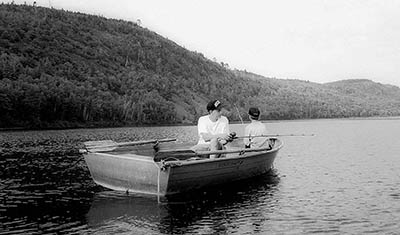
It’s a heck of a lot harder going up than it is coming down. Especially when there’s a canoe on top of your head.
“That’s what’s always saved this lake, the fact you couldn’t back a boat to it and take off,” said former park manager Ron Welton.
Still, there are enough backcountry anglers, fishermen with a backpack or a belly boat, for biologists to worry about their impact on what many consider one of the state’s premier smallmouth bass fisheries.
That has resulted in redesignating Lake of the Clouds, already non-motorized, as catch-and-release only. Have fun fishing for bass that can weigh four to five pounds; just make sure that when you’re in camp, it’s macaroni-and-cheese you’re chowing down on.
More on Top Than the Bottom
Perhaps the most amazing aspect of Michigan’s most beautiful lake is the large number of people who come to view it, park officials estimate more than 400,000 a year. But possibly less than one percent of the visitors who see it from the top ever hike down to experience the lake from the bottom.
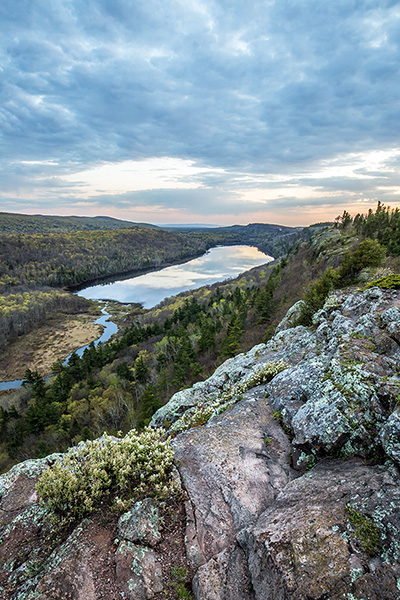
That creates the unusual paradox where you can be in a wilderness-like setting at the west end of the lake, only to look up and see a couple of hundred people at the edge of the Escarpment above.
On the other hand, no matter how crowded the overlook is or how many RVs are parked at the end of M-107, Lake of the Clouds is always this quiet body of water from below.
You can reach the lake from either the north or south, but only on foot.
The quickest hike in is from the Escarpment, where the North Mirror Lake Trail descends a half-mile to the shoreline via a series of switchbacks. When it bottoms out, you cross a long boardwalk that skirts the west end.
The most adventurous trek in is from the south. It’s possible to begin at the end of Summit Peak Road, climb over the 1,958-foot-high peak, the highest point in the park and third highest in the state, and then descend rapidly to the South Mirror Lake Trail.
The trail climbs several other ridges and, in 2.5 miles, reaches Mirror Lake, from where you pick up the south end of the North Mirror Lake Trail.
Still heading north, it’s another 3.5 miles to Lake of the Clouds, which takes most hikers a good three hours to cover. That’s because in one mile-long stretch, you descend 480 feet through a stunning gorge-like area.
This is major elevation loss.
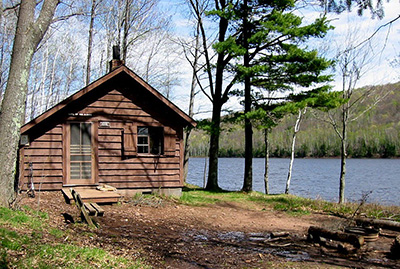
The reward is arriving at Lake of the Clouds, and having worked so hard, you might as well spend a night. The choices are either four backcountry campsites on the southwest corner or the Hilton.
This particular Hilton is the Lake of the Clouds Cabin, a four-bunk unit located a few feet from the north shore. From the window and a bench outside, there is a clear view of the lake as well as the ridges on the south side.
There’s no in-room jacuzzi, but it does come with a rowboat. You can fish in comfort all day and, best of all, you don’t have to carry it back up the Escarpment.
That alone might be worth a $100 a night.
Reservations are necessary for the cabins and backcountry campsites in Porcupine Mountains Wilderness State Park and are made through Michigan State Park Online Reservations (800-44-PARKS; www.midnrreservations.com). You can reserve campsites and cabins six months before your arrival date. By going online, you can see which sites are still available and read descriptions of them.
